
Market Minds Advisory
1,4-Dicyclohexylbenzene Market

1,4-Dicyclohexylbenzene Market: Liquid Crystal, OLED, and Specialty Polymer Intermediate Demand Through 2036

1,4-Dicyclohexylbenzene sits almost entirely inside East Asia's display supply chain, and a single Chinese panel maker's capacity decision now moves this intermediate's demand curve more than any global electronics forecast possibly could.

Lead Analyst

Bilal Shaikh

Published

September 2026

Make Smarter Decisions with Customized Research Insights

Request a free sample report and evaluate market opportunities, growth trends, and competitive dynamics relevant to your business needs.

2025 MARKET VALUE$0.1BMarket Size 2025
2036 FORECAST VALUE$0.2BBase Case , 2026 to 2036
CAGR 2026 TO 20369.2 %Bull 10.4% / Bear 8.0%
INCREMENTAL OPPORTUNITY$0.1BNet 10- year value creation
EXPANSION MULTIPLE2.37x2036 value over 2026 base
Strategic Levers
M&A Pipeline
Regional Outlook
Country Rankings
Competitive Intelligence
Segmental Deep-dive
Call-Us : 91 93563 13602

Executive Snapshot and Market Trajectory

1,4-Dicyclohexylbenzene has become a genuine bellwether for East Asian display manufacturing rather than a generic fine chemical intermediate, since its two largest applications, liquid crystal and OLED material synthesis, sit almost entirely within a handful of Chinese, Korean, and Japanese panel and materials supply chains.
OLED material intermediate demand is now the fastest-growing application, expanding at roughly 13.5% annually as foldable phone and OLED television production scales across major panel manufacturers, well over 45% faster than the wider market's pace. East Asia anchors well over four in ten dollars of global value through China's rapidly expanding domestic panel capacity, while South Korean and Japanese materials suppliers continue supplying the highest-purity electronic-grade intermediate volume.
Competitive intensity concentrates around a small group of Japanese and German fine chemical specialists who control electronic-grade purification technology, even as Chinese producers scale domestic capacity to reduce import dependence for standard liquid crystal-grade material. Purity specification, not raw production volume, increasingly determines which suppliers win long-term contracts with panel and materials manufacturers, while foldable display growth reshapes which downstream application actually drives incremental intermediate demand.
Market Definition
The 1,4-dicyclohexylbenzene market covers commercial production and sale of the compound as a chemical intermediate used in liquid crystal material synthesis, OLED material synthesis, specialty engineering polymer modification, heat transfer fluid formulation, and fine chemical applications. It excludes finished liquid crystal mixtures, formulated OLED materials, and finished display panels, which the industry classifies as separate downstream product categories.
Base Year Value
$0.1B in 2025 (MMA Primary Research Dataset, August 2026)
Forecast Period
2026 to 2036, eleven discrete annual values
CAGR
9.2% base case. Bull 10.4%. Bear 8.0%.
Fastest Growth Segment
OLED Material Intermediate: 13.5% CAGR
Fastest Growth Country
China: 12.5% CAGR
Fastest Growth Region
South Asia and Pacific: 11.2% CAGR
Largest Region
East Asia: 43% of 2025 global value
Market Leaders
Merck KGaA, JNC Corporation, DIC Corporation, Tokyo Chemical Industry Co Ltd, Idemitsu Kosan Co Ltd. Source: MMA Analysis based on company annual reports.
Primary Survey
n=3,800 procurement and R&D decision-makers, Q4 2025, six countries
Methodology
Demand-side build-up, cross-validated against public data, 47 expert interviews

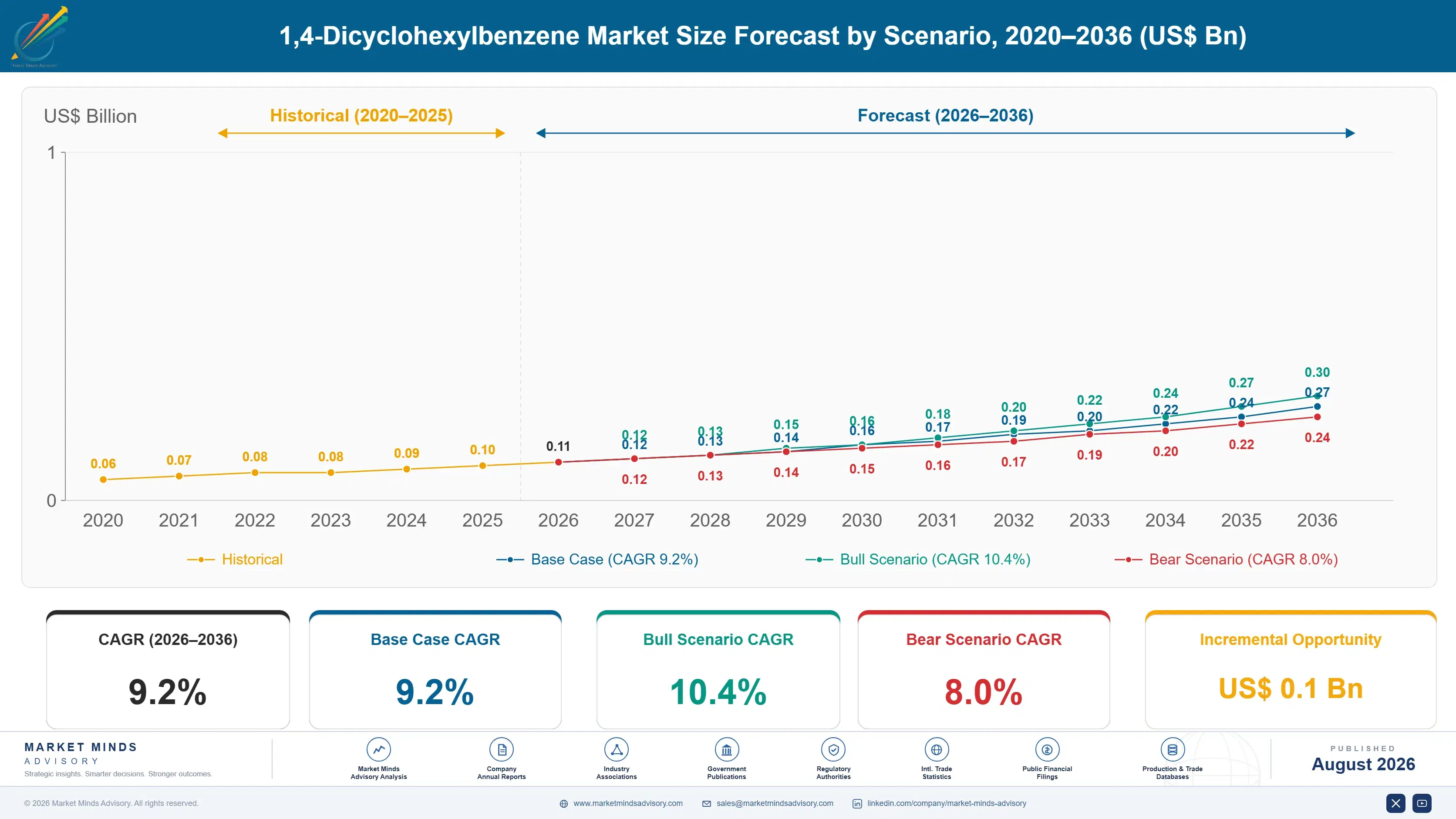
1,4-Dicyclohexylbenzene Market Forecast Scenarios

1-4-dicyclohexylbenzene-market-trends-size-forecast-scenario-1787464191965
1,4-Dicyclohexylbenzene demand grew unevenly from 2020 to 2025, as pandemic-era electronics demand briefly lifted liquid crystal display panel production before OLED material intermediate demand accelerated the underlying growth trajectory further from 2023 onward. Chinese domestic panel capacity additions redirected a meaningful share of intermediate sourcing away from Japanese and Korean suppliers across the period. The market grew at an 8.0% historical CAGR from 2020 to 2025, slower than the forecast pace as OLED-specific intermediate demand only fully scaled in the final years.
The base case carries 1,4-dicyclohexylbenzene to a 9.2% CAGR through 2036 on three mechanisms. First, foldable smartphone and OLED television production keeps scaling across major panel manufacturers, requiring increasingly specified electronic-grade intermediate volume. Second, Chinese domestic panel capacity expansion keeps pulling intermediate demand toward domestic Chinese fine chemical suppliers rather than imported Japanese and Korean material. Third, specialty engineering polymer applications keep adding incremental demand as high-performance material formulators specify this intermediate for its thermal and mechanical property contribution.
The bull case, 10.4%, assumes foldable display adoption and OLED television penetration accelerate faster than currently projected across major consumer electronics categories worldwide. The bear case, 8.0%, assumes liquid crystal display demand declines faster than OLED material intermediate demand can offset, capping overall volume growth even as electronic-grade purity requirements continue pushing pricing higher across the category.

An Intermediate Tracking East Asia's Display Supply Chain

1,4-Dicyclohexylbenzene's commercial identity is inseparable from East Asia's display manufacturing supply chain, since liquid crystal and OLED material synthesis together account for the overwhelming majority of global demand across a concentrated set of Chinese, Korean, and Japanese panel and materials manufacturers with few meaningful buyers located elsewhere.
MARKET CONCENTRATIONCR5: 38%Top five fine chemical specialists hold well under half of sales
AVERAGE SELLING PRICEUSD 68 per kilogram electronic gradePurity grade drives sharply different pricing tiers overall
TOP PRODUCING COUNTRYChina: 34% of global production capacityDomestic panel manufacturing base anchors intermediate production scale
EXPORT TRADE INTENSITY41% of output crosses a borderCross border trade links Japanese purification capacity to regional buyers
FEEDSTOCK COST SHARE35% to 45% of COGSCyclohexylbenzene and hydrogenation feedstock pricing drives volatility
OLED GRADE PRICE PREMIUM2x to 4x over standard liquid crystal gradeElectronic-grade purity commands far higher pricing overall
Buyers split sharply by purity specification and application sophistication. OLED material manufacturers require electronic-grade purity documentation and consistent batch-to-batch specification that standard liquid crystal-grade production was never built to provide, narrowing the qualified supplier base considerably relative to broader fine chemical intermediate categories. Specialty polymer formulators instead specify standard industrial-grade material, competing largely on delivered cost rather than purity documentation.
Over the next decade, OLED material demand should keep pulling value toward higher-margin electronic-grade production, while Chinese domestic panel capacity expansion keeps redirecting a growing share of intermediate sourcing toward domestic Chinese fine chemical suppliers rather than imported Japanese and Korean material. Purification technology, not raw synthesis capacity, increasingly looks like the defining competitive differentiator separating premium suppliers from commodity intermediate producers.
"Almost nobody outside the display industry has heard of this compound, yet a single foldable phone launch delay at one Korean manufacturer can move global pricing more than any broader chemical demand trend."
Director, Electronic and Specialty Chemicals Practice · MMA Chemicals and Materials Practice · August 2026

Market Trends

Foldable Display Growth Lifts OLED Intermediate Demand

Foldable smartphone production has scaled meaningfully across major Korean and Chinese device manufacturers, and foldable display architecture requires OLED material formulations with more demanding flexibility and durability specifications than standard rigid OLED panels previously required. This shift is pulling 1,4-dicyclohexylbenzene demand toward higher-purity electronic-grade production specifically engineered for foldable-compatible OLED material synthesis, a specification tier that commands meaningfully higher pricing than standard OLED-grade material. Several Japanese and Korean materials suppliers have expanded dedicated foldable-grade purification capacity since 2023, recognizing that this specification tier represents the fastest-growing segment within an already fast-growing OLED material intermediate category overall.
Market Impact: OLED television demand grows 11.5% annually
Chinese Domestic Panel Capacity Redirects Sourcing

Chinese panel manufacturers including BOE and TCL CSOT have continued expanding domestic OLED and liquid crystal display production capacity, reducing the country's historical reliance on imported Japanese and Korean panels and, increasingly, the upstream materials that supply them. Chinese fine chemical producers have responded by scaling domestic 1,4-dicyclohexylbenzene production capacity specifically to serve this growing domestic panel manufacturing base, capturing intermediate demand that previously flowed to Japanese and Korean suppliers by default. This domestic sourcing shift is reshaping global trade patterns for the intermediate considerably faster than underlying panel production growth alone would suggest, given how directly Chinese materials policy now targets supply chain self-sufficiency.
Market Impact: Specialty polymer demand grows 8.8% annually

Market Opportunities and Growth Drivers

OLED Television Penetration Sustains Volume Growth

OLED television production continues gaining share against traditional liquid crystal display televisions across premium consumer electronics segments, and OLED panel manufacturing requires 1,4-dicyclohexylbenzene as a synthesis intermediate for key OLED material components that liquid crystal panels do not require in comparable volume. Major panel manufacturers have announced continued OLED television capacity expansion through 2028, tied directly to sustained premium consumer electronics demand growth across North American, European, and increasingly Chinese domestic markets. That combination of premium segment share gains and continued capacity investment gives OLED-driven intermediate demand a durability that broader consumer electronics volume cycles do not always provide on their own.
Market Impact: Purification capex limits entry by 20%

Specialty Polymer Applications Add Incremental Demand

High-performance engineering polymer formulators increasingly specify 1,4-dicyclohexylbenzene for its thermal stability and mechanical property contribution in specialty applications spanning automotive, aerospace, and industrial component manufacturing beyond the electronics sector entirely. This diversification gives the intermediate a demand base only partially correlated with display panel production cycles, providing some insulation against electronics-specific demand volatility that pure display-focused suppliers do not share. Several specialty polymer manufacturers have expanded qualification programs specifically incorporating this intermediate into next-generation formulations, a validation process that typically takes multiple years but creates durable, sticky demand once formulations reach commercial production scale.
Market Impact: OLED substitution cuts LC-grade demand 8%

Market Restraints and Challenges

Electronic-Grade Purification Requires Significant Capital Investment

Producing OLED-grade 1,4-dicyclohexylbenzene requires purification technology and quality control infrastructure considerably more sophisticated than standard liquid crystal-grade or industrial-grade production, creating a meaningful capital barrier that limits how quickly new suppliers can credibly enter the highest-margin segment of the market. The underlying cause is that OLED material synthesis tolerates far less trace impurity contamination than liquid crystal applications, requiring specialized distillation and analytical testing capability that most standard fine chemical producers have not historically maintained. That capital barrier concentrates electronic-grade supply among a narrow group of established Japanese, German, and increasingly Chinese specialists. Some mid-sized producers are responding by licensing purification technology rather than developing it independently from scratch.
Market Impact: Foldable-grade demand grows 15% annually

Long-Term OLED Substitution Pressures Liquid Crystal Demand

OLED display technology continues gaining share against liquid crystal displays across premium consumer electronics categories, gradually eroding the liquid crystal-grade intermediate demand base that historically represented the majority of overall 1,4-dicyclohexylbenzene consumption before OLED material demand began scaling meaningfully. The underlying cause is that OLED displays offer genuine performance advantages including superior contrast and thinner form factor that liquid crystal technology cannot fully match regardless of continued liquid crystal material innovation investment. That substitution pressure caps liquid crystal-grade volume growth even as OLED-grade demand more than offsets the decline in aggregate category terms. Producers are responding by shifting capacity investment decisively toward OLED-grade purification capability.
Market Impact: Domestic Chinese sourcing grows 14% yearly
3 additional market trends, 3 additional growth drivers, and 3 additional restraints and challenges are covered in the full report. Contact sales@marketmindsadvisory.com to access the complete intelligence.

Segment CAGR and Growth Architecture

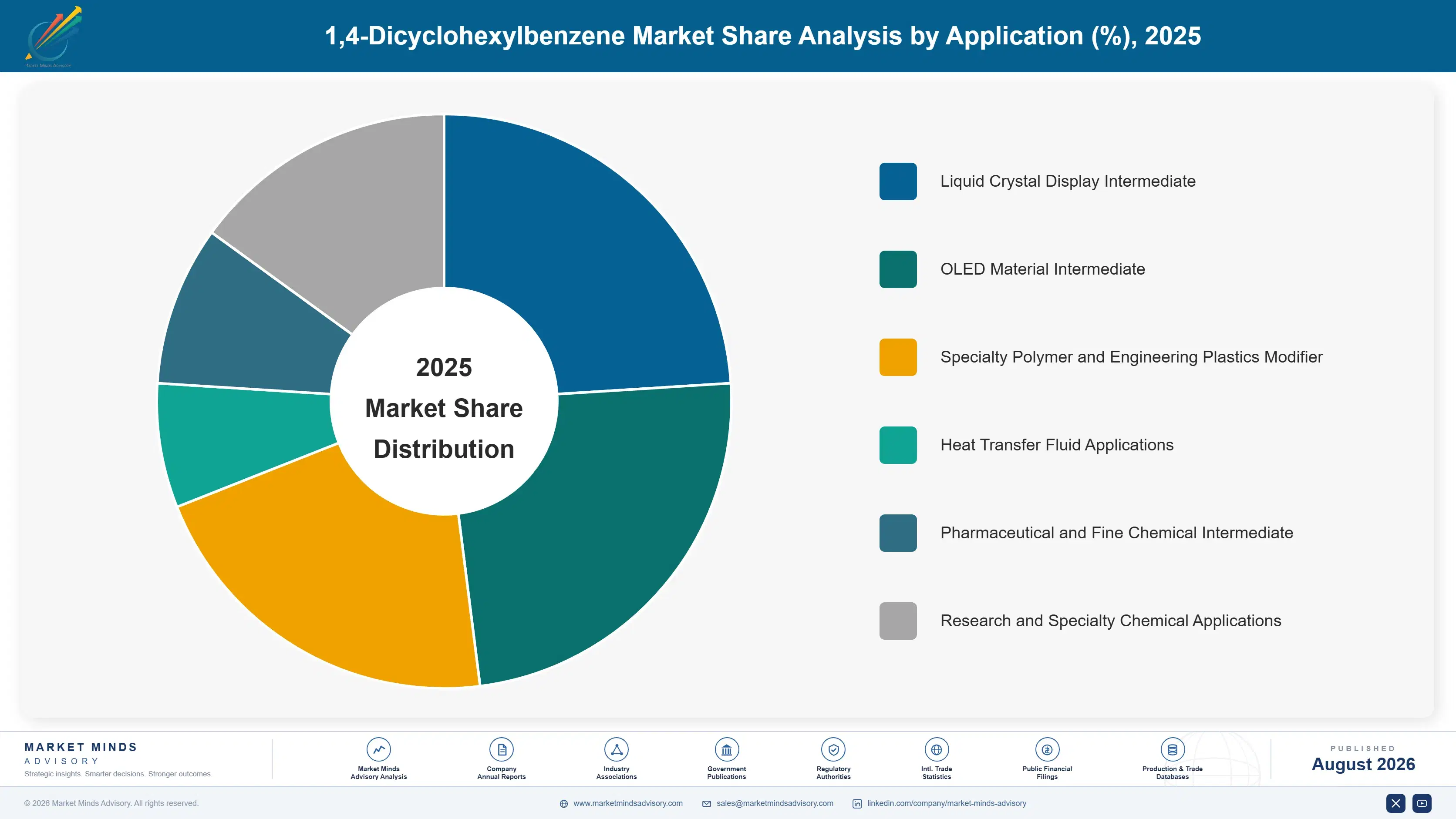
Segmentation follows end-use application, a single commercial logic tying each buyer group to distinct purity requirements, certification needs, and price sensitivity. Liquid crystal, OLED, specialty polymer, heat transfer fluid, pharmaceutical, and research applications each specify this intermediate differently, keeping upstream purification economics and downstream commercial dynamics from blurring together across the category.
1-4-dicyclohexylbenzene-market-trends-market-share-analysis-1787464192505

OLED Material Intermediate

OLED material intermediate demand is growing at 13.5% annually, well over 45% faster than the wider market's 9.2% pace, as foldable smartphone and OLED television production scales across major Korean, Chinese, and Japanese panel manufacturers requiring increasingly specified electronic-grade material. Buyers require documented purity and consistent batch-to-batch specification considerably stricter than liquid crystal-grade applications demand, narrowing the qualified supplier base to established Japanese, German, and increasingly Chinese purification specialists. Retail pricing for OLED-grade material runs two to four times above standard liquid crystal-grade equivalents, reflecting both purification investment and the willingness of panel manufacturers to pay for consistent electronic-grade quality across large-scale production runs. Merck KGaA and JNC Corporation have both prioritized capital investment in dedicated OLED-grade purification capacity, recognizing it as the segment best positioned to capture continuing foldable and premium television demand growth.
CAGR 13.5%

Specialty Polymer and Engineering Plastics Modifier

Specialty polymer and engineering plastics modifier demand grows at 11.0% annually, driven by high-performance formulators specifying this intermediate for thermal stability and mechanical property contribution across automotive, aerospace, and industrial component applications beyond the electronics sector entirely. This segment benefits from demand only partially correlated with display panel production cycles, giving it a diversification advantage that pure electronics-focused segments of the category do not share to the same degree. Qualification into specialty polymer formulations typically requires multi-year validation testing, but creates durable, sticky demand once formulations reach commercial production scale across automotive and industrial manufacturing customers. Several specialty chemical producers have expanded dedicated capacity for this application specifically, recognizing it as a genuine diversification opportunity away from display industry demand cycles.
CAGR 11.0%
Full segment breakdown across 6 segments available in the complete report.

Regional Architecture and Country Demand Map

1,4-Dicyclohexylbenzene production and consumption concentrate overwhelmingly in East Asia, where China, South Korea, and Japan together host nearly the entire global display panel and materials manufacturing supply chain. North America and Western Europe carry only residual demand relative to their broader specialty chemical industry scale, reflecting how narrowly this intermediate's end-use applications concentrate geographically.

North America

United States demand anchors North American 1,4-dicyclohexylbenzene consumption, driven primarily by specialty polymer and engineering plastics formulators rather than any domestic display panel manufacturing base, since the country hosts little meaningful liquid crystal or OLED panel production capacity of its own currently. Research institutions and pharmaceutical fine chemical applications add a smaller but steady additional demand base tied to the country's broader life sciences and specialty chemical research infrastructure. Canada follows a similar consumption pattern at considerably smaller scale, with comparable specialty polymer and research application trends. Growth here tracks close to the global average, reflecting demand driven primarily by specialty polymer qualification programs rather than any electronics manufacturing base of consequence within the region.
Share: 22% | CAGR: 8.5% (2026 to 2036)

Western Europe

Western Europe's 1,4-dicyclohexylbenzene demand centers on Germany, where Merck KGaA's substantial liquid crystal and specialty materials research and production infrastructure anchors regional demand considerably more than any domestic display panel manufacturing capacity, since Europe hosts essentially no meaningful panel production of its own currently. France and the Netherlands contribute smaller demand tied to specialty chemical research and pharmaceutical intermediate applications rather than electronics manufacturing specifically. Growth trails East Asia and South Asia and Pacific considerably as the region's demand remains fundamentally disconnected from the panel manufacturing capacity expansion driving global category growth, even as Merck's research and materials science leadership sustains a meaningful specialty chemical demand base regardless.
Share: 18% | CAGR: 7.5% (2026 to 2036)
Regional intelligence for 5 additional markets available in the complete report: East Asia, South Asia and Pacific, Latin America, Middle East and Africa, Eastern Europe. Contact sales@marketmindsadvisory.com.
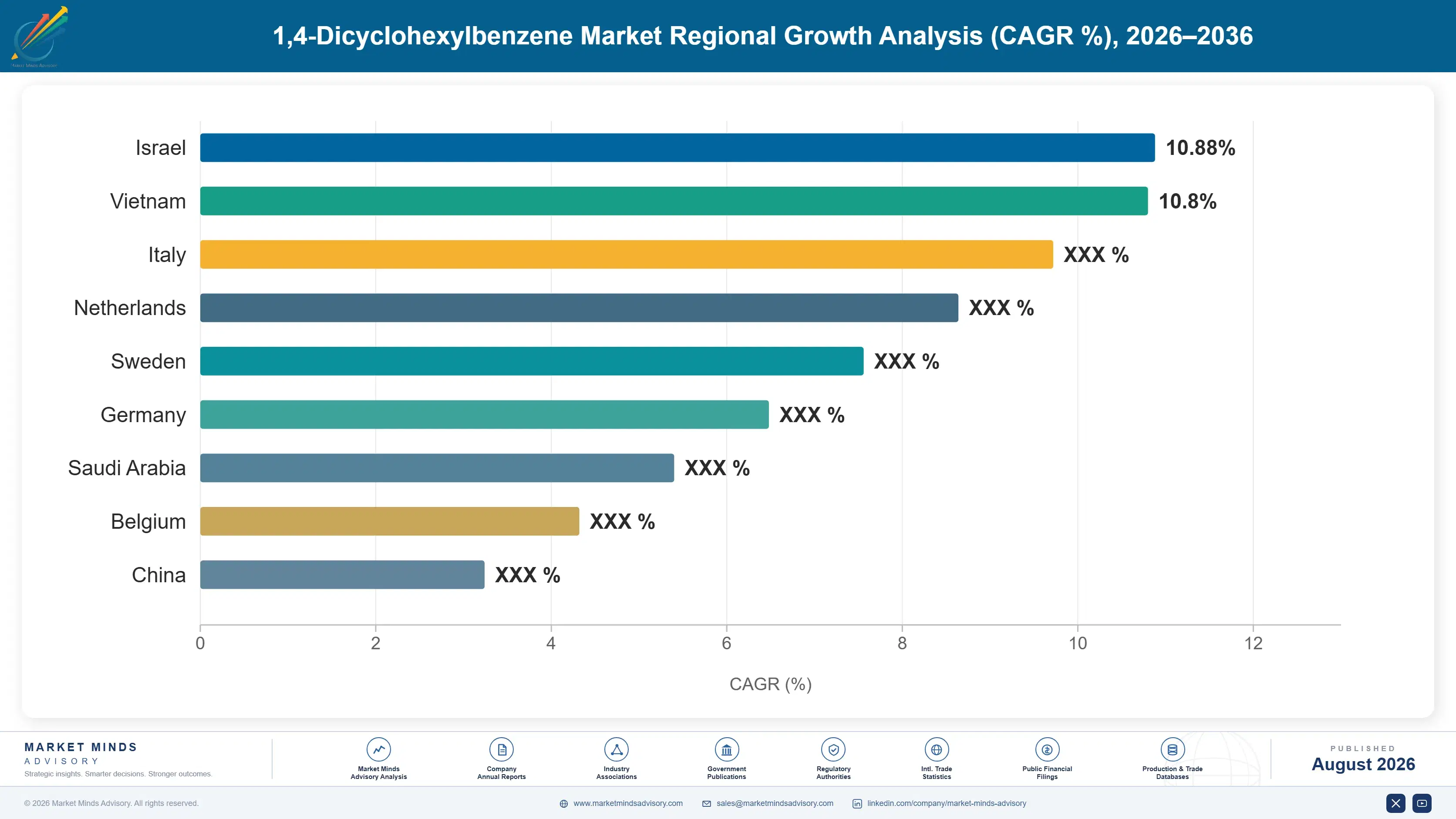
1-4-dicyclohexylbenzene-market-trends-country-cagr-analysis-1787464193028

Where Intermediate Producers Can Capture Margin

Margin defense in 1,4-dicyclohexylbenzene increasingly depends on moving beyond commodity liquid crystal-grade pricing toward positioning that lets a producer charge for OLED-grade purification, specialty polymer qualification, or domestic Chinese manufacturing presence. The four moves below target the fastest-growing buyer segments most willing to pay well above commodity pricing for genuine differentiation.

Build OLED-Grade Purification Capacity Ahead of Demand

OLED-grade material commands retail pricing running two to four times above standard liquid crystal-grade equivalents, and demand from panel manufacturers has grown considerably faster than the industry's dedicated electronic-grade purification capacity currently available across major producing regions. Producers that invest in purification technology now capture premium contracts before competitors establish comparable technical capability, since panel manufacturers increasingly specify electronic-grade purity as a baseline formulation requirement for foldable and premium display applications. The purification investment requires meaningful capital and analytical testing infrastructure, but the roughly 2x to 4x margin uplift over standard grade more than justifies the cost for most established fine chemical specialists.
Market Impact: OLED-grade purification commands a 2x to 4x premium

Expand Chinese Domestic Manufacturing Presence Now

Chinese panel manufacturers increasingly prefer domestic intermediate sourcing over imported Japanese and Korean material, giving producers with local manufacturing presence a durability that export-focused strategies alone cannot match given China's continued domestic capacity expansion trajectory across both OLED and liquid crystal panel production. Producers that build manufacturing presence now in China capture volume growth before competitors establish comparable regional infrastructure and panel manufacturer relationships within the country's rapidly consolidating display supply chain. The investment requires meaningful capital and navigation of Chinese regulatory and customer qualification structures, but the volume growth available domestically exceeds most comparable export market opportunities currently available.
Market Impact: Chinese manufacturing presence captures roughly 14% growth

Qualify Into Specialty Polymer Formulations Early

Specialty polymer qualification requires multi-year validation testing but creates durable, sticky demand once formulations reach commercial production scale across automotive, aerospace, and industrial manufacturing customers largely disconnected from display industry demand cycles. Producers that invest in qualification programs now capture long-term contracts before competitors establish comparable formulation relationships with major specialty polymer manufacturers seeking genuine diversification away from electronics-cycle-dependent revenue. The qualification investment requires meaningful technical support and patience given multi-year validation timelines, but the roughly 25% margin premium and revenue diversification it provides justifies the cost for producers seeking demand insulation from display industry volatility.
Market Impact: Specialty polymer qualification adds roughly a 25% premium

Secure Long-Term Panel Manufacturer Supply Contracts

Major panel manufacturers increasingly prefer multi-year supply commitments over spot purchasing, since supply disruption during large-scale production runs carries genuine manufacturing continuity risk that display manufacturers cannot easily absorb given continuous production line operation requirements. Producers that secure these contracts now lock in demand and pricing before competitors capture the same customers, since panel manufacturers rarely switch intermediate suppliers once a purification and supply relationship has been validated across successive production cycles. The contracting investment requires meaningful sales and technical support capacity, but the multi-year revenue visibility it provides justifies the cost for most established intermediate producers.
Market Impact: Long-term contracts typically lock in 18% more volume

Who Controls the Margin Pool

Competitive concentration sits at a moderate CR5 of 38%, reflecting a market split between established Japanese and German fine chemical specialists competing on electronic-grade purification technology and Chinese domestic producers competing primarily on cost and proximity to expanding panel manufacturing capacity. The gap between category leaders and mid-tier challengers remains meaningful, built on decades of purification technology and panel manufacturer relationships.
Competitive activity currently runs along three lines. Established Japanese and German specialists compete on OLED-grade purification technology and panel manufacturer certification breadth, applying technical expertise smaller competitors cannot easily replicate. Chinese domestic producers compete on cost and proximity to rapidly expanding domestic panel capacity. Specialty polymer suppliers compete on qualification depth and formulation support, since access to validated formulation relationships increasingly determines who wins long-term industrial contracts.

Pressure is building from two directions. Chinese domestic producers are increasingly moving upmarket into OLED-grade purification, challenging Japanese and German majors on territory once considered defensible through purification technology investment alone. Meanwhile specialty polymer qualification is becoming a genuine competitive differentiator, rewarding producers willing to fund multi-year validation programs over those competing purely on commodity liquid crystal-grade pricing. Rankings over the next five years will favor whoever combines OLED-grade purification capability with credible Chinese domestic manufacturing presence.
1-4-dicyclohexylbenzene-market-trends-company-positioning-matrix-1787464193548

Competitive Moat and Risk Dimensions

MERCK KGAA

Moat: Established liquid crystal materials leadership

Merck holds decades of liquid crystal and specialty materials research investment and purification expertise that newer entrants, domestic or international, cannot replicate on any reasonable timeline, giving it technical credibility and panel manufacturer certification depth that smaller specialized competitors genuinely struggle to match across multiple regions.
MERCK KGAA

Risk: Limited Chinese domestic manufacturing scale

Merck's production infrastructure remains concentrated primarily in Germany and select Asian facilities rather than large-scale Chinese domestic manufacturing, exposing the company to potential share loss as Chinese panel manufacturers increasingly prefer domestic intermediate sourcing over imported German or Japanese material.
JNC CORPORATION

Moat: Deep Japanese electronic-grade purification expertise

JNC's established electronic-grade purification technology and long-standing relationships with major Korean and Japanese panel manufacturers give it technical credibility and supply reliability that newer, less established competitors have not built at comparable depth, particularly for the most demanding foldable-grade OLED material specifications.
JNC CORPORATION

Risk: Smaller scale limits Chinese market share

JNC's more specialized, smaller scale relative to larger diversified chemical conglomerates limits how quickly it can fund Chinese domestic manufacturing expansion, potentially constraining its ability to capture the full Chinese panel capacity growth surge without additional external capital investment or a strategic partner.

Players Tracked

Prominent Players

Merck KGaA
JNC Corporation
DIC Corporation
Tokyo Chemical Industry Co Ltd
Idemitsu Kosan Co Ltd

Other Key Players

Osaka Gas Chemicals Co Ltd
TCI America
Shanghai Aladdin Biochemical Technology Co Ltd
Wuhan Xinshunyuan Fine Chemical Co Ltd
Zhejiang NHU Company
Combi-Blocks Inc
Alfa Aesar (Thermo Fisher Scientific)
Fujifilm Wako Pure Chemical Corporation
Tosoh Corporation
LG Chem Ltd
Duksan Neolux Co Ltd
Yantai Wanrun Advanced Materials Co Ltd
Sumitomo Chemical Co Ltd
Hansol Chemical Co Ltd
Nichem Fine Technology Co Ltd

Recent Developments

APRIL 2024

JNC Corporation expands foldable-grade OLED purification capacity

JNC commissioned expanded electronic-grade purification capacity specifically engineered for foldable-compatible OLED material synthesis, responding to sustained Korean and Chinese panel manufacturer demand growth. The investment was an organic capacity expansion, not a joint venture or acquisition of any competing purification specialist.
Signal: Signals established Japanese specialists prioritizing foldable-grade capacity well ahead of confirmed long-term demand growth trajectories.
SEPTEMBER 2024

Yantai Wanrun expands domestic Chinese production capacity

Yantai Wanrun Advanced Materials announced expanded domestic intermediate production capacity at its Chinese facilities, responding directly to growing demand from BOE and TCL CSOT as Chinese panel manufacturers prioritize domestic sourcing. The expansion was an organic capacity investment, not a joint venture or acquisition of any competing Chinese producer.
Signal: Signals Chinese domestic producers scaling capacity well ahead of continued panel manufacturing expansion trajectory nationwide.
JANUARY 2025

Merck acquires minority stake in specialty purification technology startup

Merck acquired a minority equity stake in a specialty purification technology startup to accelerate access to next-generation electronic-grade purification methods ahead of anticipated foldable display demand growth. The transaction was a minority equity investment, not a full acquisition, merger, or joint venture arrangement.
Signal: Signals established specialty chemical majors buying innovation access rather than building novel purification capability internally.

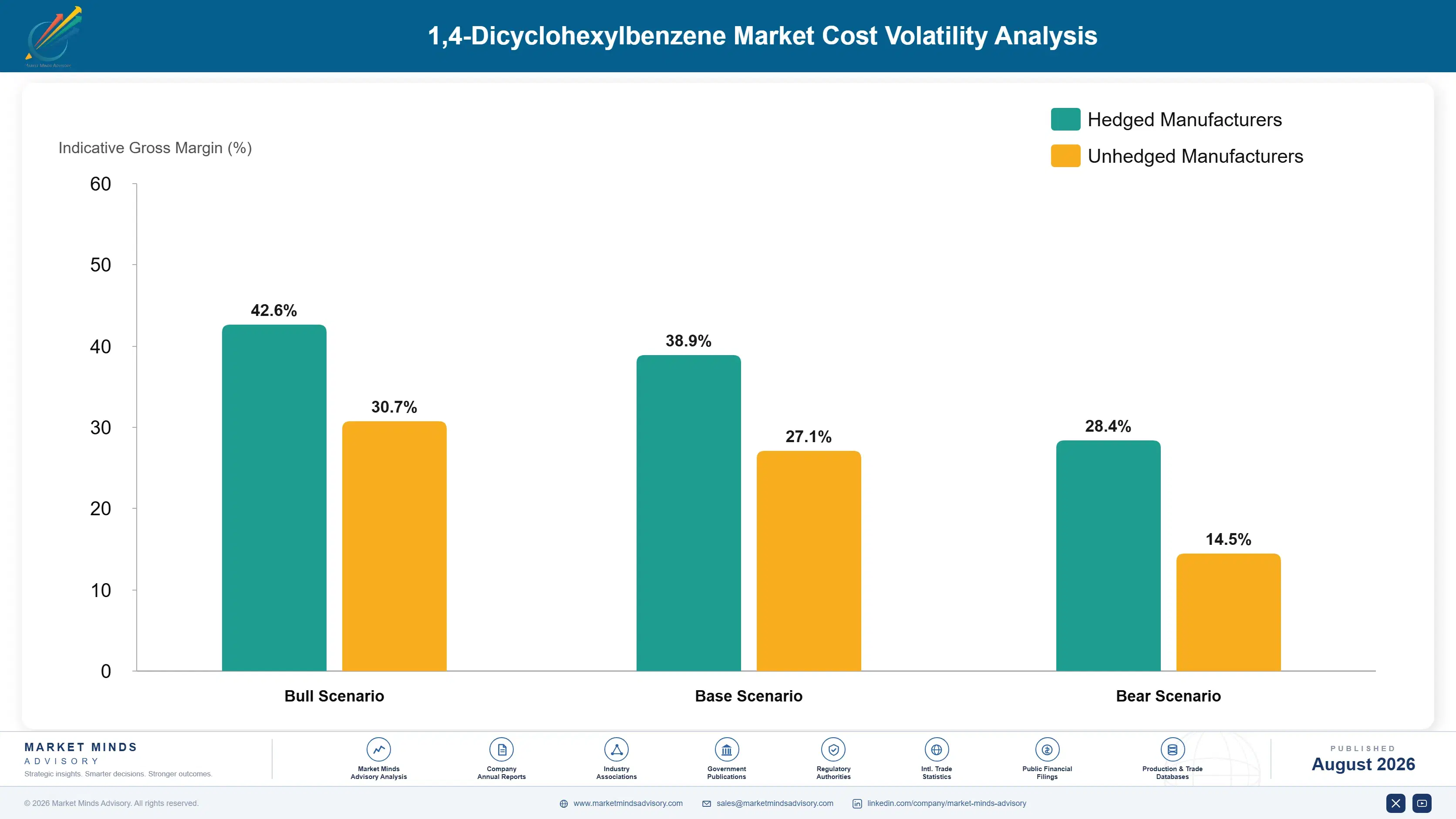
Cyclohexylbenzene Feedstock Sets The Margin Floor

Cyclohexylbenzene and related hydrogenation feedstocks account for 35% to 45% of production cost for 1,4-dicyclohexylbenzene, sourced from petrochemical supply chains whose pricing tracks broader benzene and cyclohexane commodity markets rather than any intermediate-specific supply and demand pattern. Purification and analytical testing costs add a further meaningful share, varying considerably depending on whether a producer targets standard industrial-grade or electronic-grade output requiring extensive trace impurity documentation.
The 2022 petrochemical price spike illustrated feedstock exposure directly. EIA data recorded benzene and related aromatic feedstock prices reaching multi-year highs through 2022 as global refining capacity tightened following Russian supply disruption. Producers without hedged forward contracts or diversified feedstock sourcing absorbed significant cost increases, passing some of that cost through to panel and polymer manufacturer customers who had few alternative low-cost intermediate supply sources to switch toward given concentrated global production capacity.

Exposure falls hardest on smaller producers without long-term feedstock contracts or diversified sourcing relationships, who must buy cyclohexylbenzene closer to spot pricing and absorb whatever margin compression results from petrochemical commodity volatility. Larger diversified fine chemical companies with established feedstock hedging and geographic sourcing diversification smooth that volatility considerably better than smaller, less capitalized regional competitors currently exposed to full commodity market swings.
1-4-dicyclohexylbenzene-market-trends-cost-volatility-analysis-1787464193744

Lock Long-Term Cyclohexylbenzene Supply Contracts

Producers negotiating multi-year feedstock supply agreements directly with petrochemical suppliers convert volatile spot pricing into a planned input cost, protecting downstream panel and polymer manufacturer pricing that resists frequent adjustments. This favors larger established producers with existing supplier relationships, but smaller producers can access similar terms through regional purchasing consortia rather than negotiating individually against larger established buyers.

Diversify Feedstock Sourcing Across Regional Suppliers

Producers reduce single-source commodity exposure by sourcing cyclohexylbenzene across multiple regional petrochemical suppliers rather than depending entirely on any single supplier relationship for the majority of feedstock volume. That diversification smooths input availability across different regional commodity market cycles, though it adds supplier qualification complexity across each additional sourcing relationship a producer incorporates into its network.

Invest In Backward Integration Into Feedstock Production

Larger producers reduce commodity feedstock exposure by investing directly in cyclohexylbenzene production capacity rather than purchasing it entirely from external petrochemical suppliers, eliminating spot market exposure for a portion of feedstock needs. This capital-intensive path suits only the largest producers, but delivers durable margin protection that persists regardless of future petrochemical market volatility across cycles.

Portfolio Architecture for Margin Defence

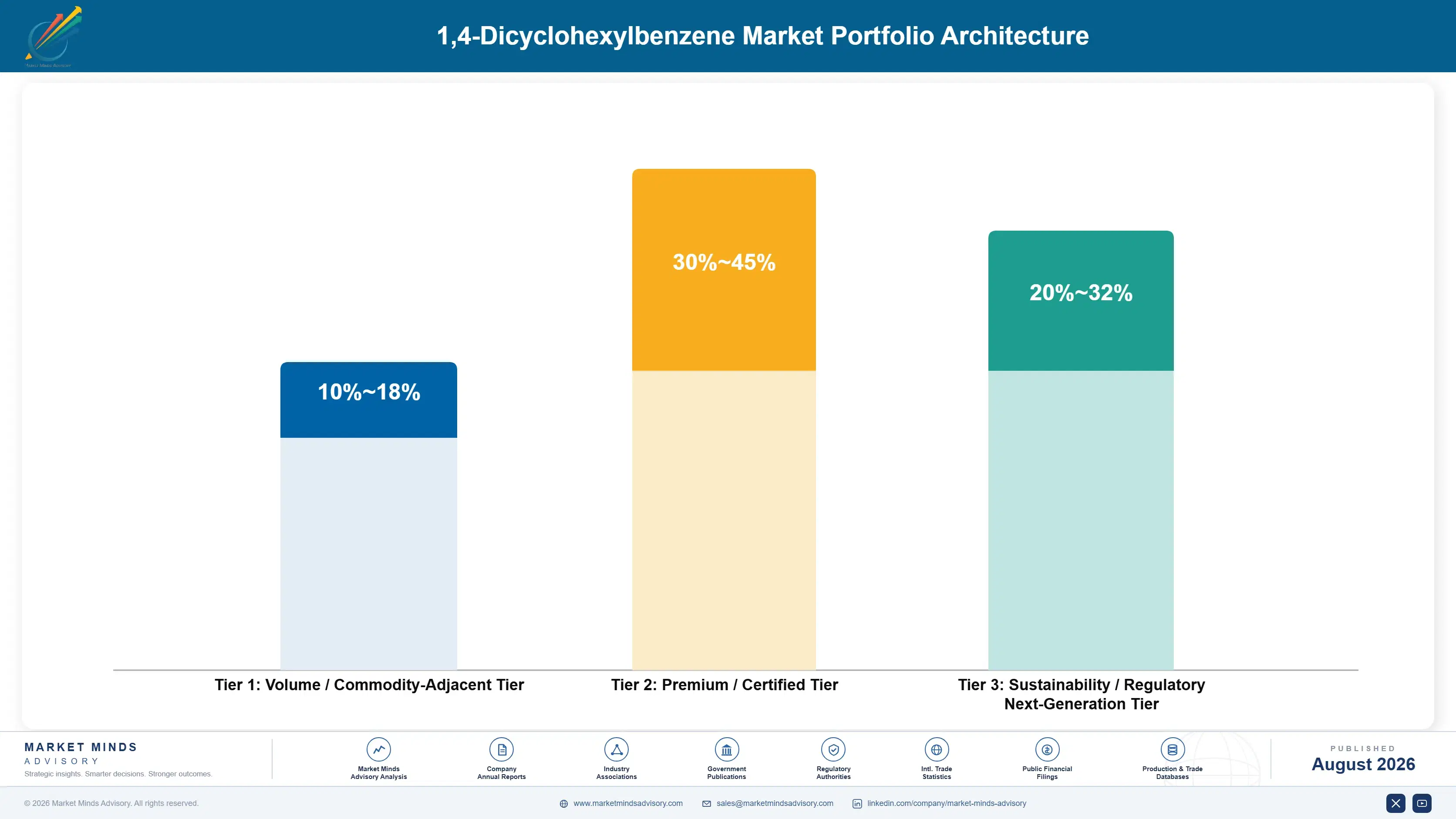
1,4-Dicyclohexylbenzene's portfolio splits into three tiers with meaningfully different margin economics. Volume liquid crystal-grade and industrial-grade material, sold through established commodity channels on price and delivered volume, competes on cost and earns steady but thin margins. OLED-grade and specialty polymer-qualified material earns substantially more, since purification documentation and formulation qualification create switching costs commodity producers cannot replicate quickly.
The tension for producers is capital allocation between two economics. Volume liquid crystal-grade production generates dependable cash flow that funds operations and research investment, while OLED-grade and specialty polymer capacity requires meaningful purification and qualification investment before generating comparable returns at much higher margin. Producers leaning entirely on liquid crystal volume risk losing share to faster-growing OLED-grade competitors, while those chasing electronic-grade investment too aggressively risk underutilized premium capacity if foldable display demand growth proves slower than currently projected.

High-value margin pools concentrate in OLED-grade and specialty polymer-qualified material carrying genuine purification or formulation differentiation that commodity liquid crystal-grade material cannot match. Frontier opportunity sits in combining Chinese domestic manufacturing presence with credible OLED-grade purification capability, letting producers capture premium pricing from panel manufacturers while retaining steady liquid crystal-grade revenue simultaneously.

Volume / Commodity-Adjacent Tier

Standard liquid crystal-grade and industrial-grade material sold through established commodity trading channels on price and delivered volume, priced close to global benchmark levels with minimal differentiation between competing regional producers nationwide.
Gross Margin: 10-18%

Premium / Certified Tier

OLED-grade and specialty polymer-qualified material carrying documented purity and formulation validation that commands sustained premiums over commodity liquid crystal-grade equivalents across panel manufacturers and specialty polymer buyers worldwide.
Gross Margin: 30-45%

Sustainability / Regulatory / Next-Generation Tier

Emerging foldable-grade and next-generation purification technologies designed to serve increasingly demanding display specifications ahead of continued foldable and flexible display adoption, though scale-up economics remain largely unproven at full commercial volume today.
Gross Margin: 20-32%
1-4-dicyclohexylbenzene-market-trends-portfolio-architecture-1787464194247

High-value Sub-segments and Strategic Watch-out

OLED Material Intermediate

OLED demand grows fastest at 13.5% annually and already commands pricing two to four times above standard liquid crystal-grade material. Japanese and German specialists investing in purification capacity and Chinese domestic producers both continue expanding, and growing foldable display demand should keep margin strong through the forecast period ahead.
Gross Margin: 30-45%

Specialty Polymer and Engineering Plastics Modifier

Specialty polymer demand grows at a healthy 11.0% annually, driven by automotive and industrial qualification programs, though multi-year validation timelines and capital requirements limit how quickly new entrants can credibly compete for this diversification-focused demand segment currently.
Gross Margin: 25-38%

Liquid Crystal Display Intermediate

Liquid crystal display intermediate remains a meaningful volume category, anchored by decades of established display manufacturing use across the industry globally. Margins stay steady but modest, competing on price and delivered volume rather than differentiation, but the segment anchors baseline category revenue today.
Gross Margin: 10-18%

Heat Transfer Fluid Applications

Heat transfer fluid demand faces gradual substitution pressure as formulators increasingly favor alternative thermal fluid chemistries offering comparable performance at potentially lower cost. Producers concentrated purely in this segment risk volume erosion over the next decade absent diversification into electronics or specialty polymer applications.
Gross Margin: 12-20%

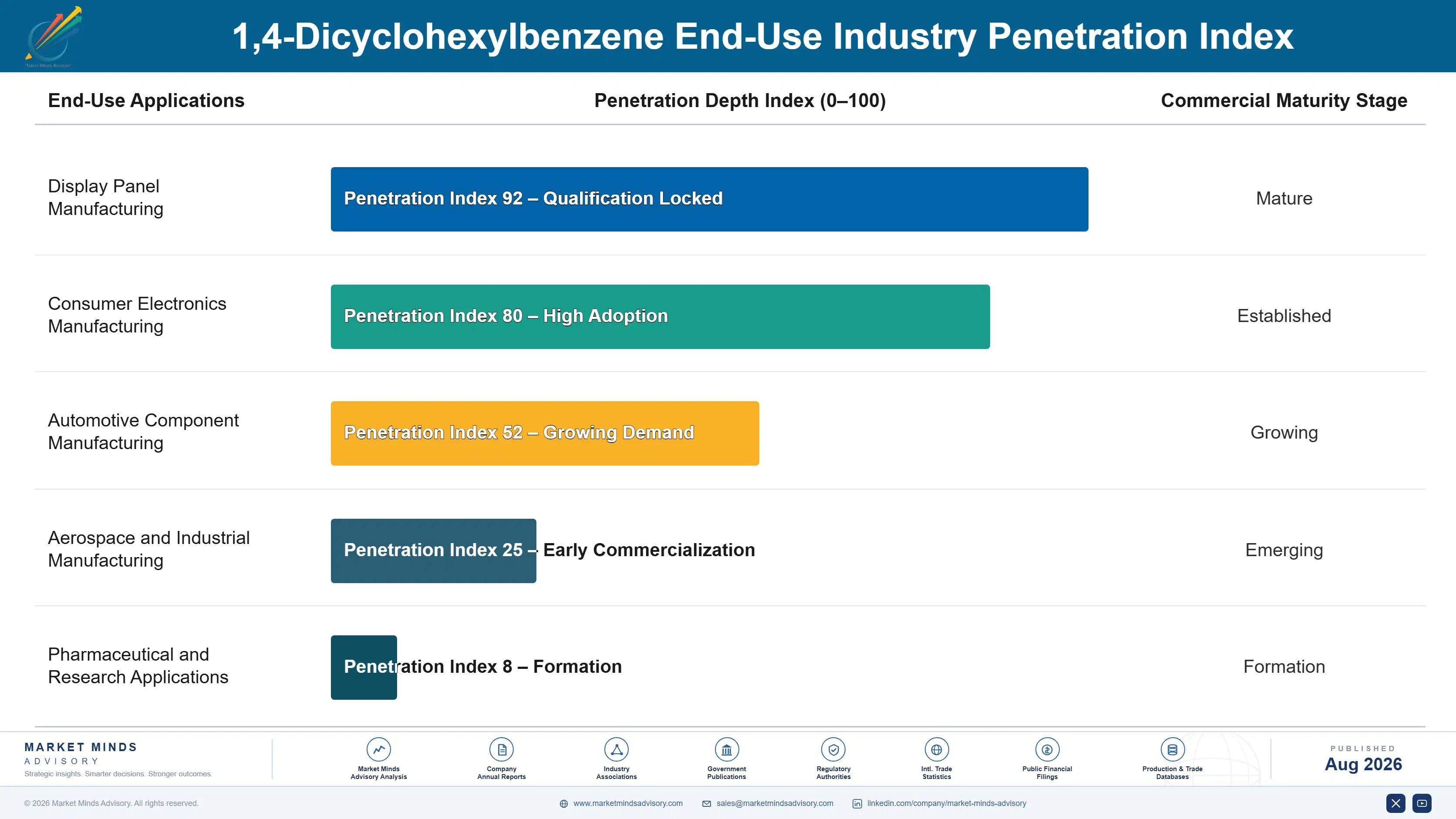
Why Panel Manufacturer Contracts Run Long

1,4-Dicyclohexylbenzene demand behaves like an annuity within panel manufacturer supply relationships, since OLED and liquid crystal material formulators qualify a supplier through extended purification validation and then reorder against that qualified source repeatedly rather than re-tendering routinely, given the production continuity risk of switching mid-formulation across a large-scale manufacturing line. Specialty polymer buyers behave similarly once qualification is complete, given the multi-year validation cost involved in establishing a new intermediate relationship.
Stickiness varies sharply by buyer sophistication and application criticality. Major panel manufacturers rarely switch intermediate suppliers once a purification relationship has been validated, given the documentation and requalification cost involved in switching mid-production. Specialty polymer formulators show similarly strong loyalty once a qualified formulation reaches commercial scale. Smaller, less sophisticated industrial buyers remain the least sticky segment, switching between suppliers more readily as commodity liquid crystal-grade pricing shifts.

Buyer profiles are shifting generationally within materials science and procurement teams specifically. Younger formulation engineers increasingly treat documented purity and traceability as standing requirements rather than negotiable preferences, a shift that favors producers who invested early in purification and quality documentation infrastructure over those still competing purely on commodity liquid crystal-grade pricing.
1-4-dicyclohexylbenzene-market-trends-end-use-penetration-index-1787464194742

Where Intermediate Producers Should Bet

These are among the four positions where our research anticipates prominent divergence between winners and laggards over the coming forecast period. Each is grounded in the demand model, the regulatory perimeter, and the announced capacity pipeline.
01 / OLED PURIFICATION INVESTMENT

Build electronic-grade capacity before foldable demand outpaces supply

OLED material intermediate demand is growing well over 45% faster than the wider market's pace, and already commands pricing two to four times above standard liquid crystal-grade material, yet most producers still lack dedicated electronic-grade purification capacity at meaningful commercial scale. Producers that invest now in purification technology position ahead of continuing foldable smartphone and premium television demand growth across every major panel manufacturer. Waiting risks ceding the category's fastest-growing and highest-margin segment permanently to competitors currently building that purification capability.
02 / CHINESE MARKET EXPANSION

Build Chinese manufacturing presence before the growth gap widens further

China's domestic panel manufacturing capacity carries meaningfully higher intermediate volume growth than most developed markets, and Chinese panel manufacturers increasingly prefer domestic sourcing over imported Japanese and Korean material as capacity expansion continues across BOE and TCL CSOT specifically. Producers that build manufacturing presence now in China capture volume growth before competitors establish comparable regional infrastructure and panel manufacturer relationships. Every producer relying purely on export sales into China risks losing share to domestically established competitors over the coming years.
03 / SPECIALTY POLYMER DIVERSIFICATION

Qualify into specialty polymer formulations before the diversification window closes

Specialty polymer qualification requires multi-year validation but creates durable, sticky demand largely disconnected from display industry cycles, giving producers genuine revenue diversification that pure electronics-focused competitors do not share. Producers that invest now in qualification programs position ahead of competitors still building comparable formulation relationships with major automotive and industrial polymer manufacturers. Every producer relying purely on display industry demand risks missing this genuine diversification opportunity permanently as qualification windows close.
04 / LONG-TERM CONTRACT PRIORITY

Lock panel manufacturers into multi-year supply agreements now

Major panel manufacturers increasingly prefer multi-year supply commitments over spot purchasing, since supply disruption during large-scale production runs carries genuine manufacturing continuity risk that display manufacturers cannot comfortably absorb given continuous production line operation requirements. Producers that secure these contracts now lock in demand and pricing before competitors capture the same customers, since manufacturers rarely switch suppliers once a purification relationship has been validated. Every producer relying purely on spot sales risks missing the category's most durable and valuable revenue opportunity entirely.

Engagement Snapshot From the Field

A live engagement with an industry participant carrying material or product regulatory and market exposure ahead of a defining policy shift, showing how our research translates into a defensible multi-year portfolio strategy.
MARKET MINDS ADVISORY · CLIENT ENGAGEMENT SUMMARY
1,4-Dicyclohexylbenzene Producer Strategic Portfolio Review and Transition Roadmap 2026·Investment Scenario on 1,4-Dicyclohexylbenzene Exposure Evaluation 2025-26
CLIENT PROFILE
A mid-sized Korean OLED materials formulator supplying intermediate compounds to major Korean and Chinese panel manufacturers approached MMA while evaluating whether to diversify 1,4-dicyclohexylbenzene sourcing beyond its historical Japanese-concentrated supplier base. The client reported annual materials revenue near USD 95 million, with this intermediate accounting for roughly 18% of total input cost and recent supply tightness following a Japanese supplier's capacity constraint (client-reported, unverified by MMA).
STRATEGIC CHALLENGE
Management faced a sourcing decision between continuing to concentrate purchasing with established Japanese suppliers offering the most reliable electronic-grade purity or diversifying toward emerging Chinese domestic suppliers at potentially lower cost but with less proven purification track records. The commercial team worried diversification risked quality inconsistency in foldable-grade applications, while the finance team questioned whether continued Japanese supplier concentration left the company overly exposed to future capacity constraints.
MMA APPROACH
MMA benchmarked purity consistency and supply reliability across the client's existing Japanese suppliers against emerging Chinese domestic alternatives, modeled total delivered cost under several diversification scenarios, and assessed the client's production continuity risk exposure under a repeat of the recent Japanese supply constraint. We also evaluated qualification timelines and testing protocols required to validate a new Chinese supplier for foldable-grade applications specifically.
KEY FINDINGS
  1. Diversifying a portion of purchasing volume toward a qualified Chinese domestic supplier reduced projected supply disruption risk substantially while adding minimal cost relative to continued full Japanese concentration.
  2. Chinese domestic suppliers showed meaningfully improved purity consistency in recent production batches, narrowing the historical quality gap with established Japanese suppliers considerably.
  3. Full diversification away from Japanese sourcing risked losing access to the most advanced foldable-grade purification technology that only established Japanese suppliers currently offer (client-reported, unverified by MMA).
  4. A hybrid approach using the Chinese supplier for standard OLED-grade volume while retaining Japanese sourcing for the most demanding foldable-grade applications balanced cost and quality risk most effectively.
CLIENT PROFILE
A mid-sized Korean OLED materials formulator supplying intermediate compounds to major Korean and Chinese panel manufacturers approached MMA while evaluating whether to diversify 1,4-dicyclohexylbenzene sourcing beyond its historical Japanese-concentrated supplier base. The client reported annual materials revenue near USD 95 million, with this intermediate accounting for roughly 18% of total input cost and recent supply tightness following a Japanese supplier's capacity constraint (client-reported, unverified by MMA).
STRATEGIC CHALLENGE
Management faced a sourcing decision between continuing to concentrate purchasing with established Japanese suppliers offering the most reliable electronic-grade purity or diversifying toward emerging Chinese domestic suppliers at potentially lower cost but with less proven purification track records. The commercial team worried diversification risked quality inconsistency in foldable-grade applications, while the finance team questioned whether continued Japanese supplier concentration left the company overly exposed to future capacity constraints.
MMA APPROACH
MMA benchmarked purity consistency and supply reliability across the client's existing Japanese suppliers against emerging Chinese domestic alternatives, modeled total delivered cost under several diversification scenarios, and assessed the client's production continuity risk exposure under a repeat of the recent Japanese supply constraint. We also evaluated qualification timelines and testing protocols required to validate a new Chinese supplier for foldable-grade applications specifically.
KEY FINDINGS
  1. Diversifying a portion of purchasing volume toward a qualified Chinese domestic supplier reduced projected supply disruption risk substantially while adding minimal cost relative to continued full Japanese concentration.
  2. Chinese domestic suppliers showed meaningfully improved purity consistency in recent production batches, narrowing the historical quality gap with established Japanese suppliers considerably.
  3. Full diversification away from Japanese sourcing risked losing access to the most advanced foldable-grade purification technology that only established Japanese suppliers currently offer (client-reported, unverified by MMA).
  4. A hybrid approach using the Chinese supplier for standard OLED-grade volume while retaining Japanese sourcing for the most demanding foldable-grade applications balanced cost and quality risk most effectively.
RECOMMENDED STRATEGY
Phase 1: Phase 1 (0 to 6 months): Qualify a Chinese domestic supplier for standard OLED-grade volume while retaining full Japanese sourcing for foldable-grade applications. Phase 2: Phase 2 (6 to 18 months): Gradually shift standard OLED-grade volume toward the qualified Chinese supplier once initial production batches confirm consistent quality. Phase 3: Phase 3 (18 to 36 months): Reassess the sourcing mix annually based on realized quality performance and Japanese supplier capacity conditions.
OUTCOME
The client qualified a Chinese domestic supplier for standard OLED-grade volume while retaining Japanese sourcing for foldable-grade applications, achieving meaningful cost savings on standard volume without compromising foldable-grade quality. The client reported improved supply security following the diversification, with no quality issues identified in the qualified Chinese volume to date (client-reported, unverified by MMA).

Frequently Asked Questions

Foundational context covering the market sizes, CAGR, scope, country, region and competition that inform every finding below. This section is provided to cover basics and most often pre-purchase conversations, answered from the MMA Primary Research Dataset.

What is the current size of the 1,4-Dicyclohexylbenzene Market?

The global 1,4-dicyclohexylbenzene market reached USD 0.093 billion in 2025, based on MMA Primary Research Dataset findings. Growth increasingly reflects OLED material demand rather than liquid crystal volume alone.

How large will the 1,4-Dicyclohexylbenzene Market be by 2036?

MMA's base case projects the market reaching USD 0.22 billion by 2036, an incremental opportunity of roughly USD 0.13 billion over the 2026 to 2036 forecast period.

What is the CAGR for the 1,4-Dicyclohexylbenzene Market 2026 to 2036?

The base case CAGR is 9.2%, with a bull case of 10.4% and a bear case of 8.0% depending on foldable display adoption pace and Chinese capacity expansion.

Which segment is growing fastest?

OLED material intermediate leads at a 13.5% CAGR, well over 45% faster than the overall market rate, as foldable display production scales across major manufacturers.

Who are the major companies in the 1,4-Dicyclohexylbenzene Market?

Leading participants include Merck KGaA, JNC Corporation, DIC Corporation, Tokyo Chemical Industry Co Ltd, and Idemitsu Kosan Co Ltd, assessed on purification capability and panel manufacturer relationships.

Which country is growing fastest?

China leads country-level growth, driven by rapidly expanding domestic OLED and liquid crystal panel manufacturing capacity that increasingly prefers domestic intermediate sourcing over imports.

Report Segmentation Architecture

The full report scope spans multiple orthogonal segmentation dimensions, with cross-tabulated demand data provided for each dimension pair. Coverage extends further to regional breakdowns, trend trajectories, and the competitive detail needed to support segment-level decision-making.

By Application

  • Liquid Crystal Display Intermediate
  • OLED Material Intermediate
  • Specialty Polymer and Engineering Plastics Modifier
  • Heat Transfer Fluid Applications
  • Pharmaceutical and Fine Chemical Intermediate
  • Research and Specialty Chemical Applications

By End-Use Industry

  • Display Panel Manufacturing
  • Consumer Electronics Manufacturing
  • Automotive Component Manufacturing
  • Aerospace and Industrial Manufacturing
  • Pharmaceutical and Research Applications

By Commercial Dimension

  • Direct Panel Manufacturer Contract Supply
  • Distributor and Trading Channels
  • Spot Market Purchasing
  • Electronic-Grade Certified Supply Agreements

By Region

  • North America
  • Western Europe
  • East Asia
  • South Asia and Pacific
  • Latin America
  • Middle East and Africa
  • Eastern Europe

Scope, Methodology, and Coverage

Every figure in this report is reproducible from documented input assumptions. The scope below maps the historical period, the forecast horizon, the segmentation dimensions, and the countries covered, alongside the underlying primary and qualitative methodology.
Historical Period
2020 to 2025
Forecast Period
2026 to 2036
Base Year
2025 (USD billions; MMA Primary Research Dataset, August 2026)
Market Definition
The 1,4-dicyclohexylbenzene market covers commercial production and sale of the compound as a chemical intermediate used in liquid crystal material synthesis, OLED material synthesis, specialty engineering polymer modification, heat transfer fluid formulation, and fine chemical applications. It excludes finished liquid crystal mixtures, formulated OLED materials, and finished display panels, which the industry classifies as separate downstream product categories.
Quantitative Units
USD billions (current prices); metric tonnes of 1,4-dicyclohexylbenzene production and trade volume where applicable
Segmentation Dimensions
By Application; By End-Use Industry; By Commercial Dimension; By Region
Regions Covered
North America, Western Europe, East Asia, South Asia and Pacific, Latin America, Middle East and Africa, Eastern Europe
Countries Covered
USA, China, Germany, France, UK, Japan, South Korea, India, Australia, Canada, Brazil, Mexico, Indonesia, Vietnam, Thailand, Malaysia, UAE, Saudi Arabia, South Africa, Nigeria, Turkey, Poland, Netherlands, Italy, Spain, Sweden, Switzerland, Argentina, Colombia, Singapore, and additional markets relevant to this sector
Key Companies Profiled
Merck KGaA, JNC Corporation, DIC Corporation, Tokyo Chemical Industry Co Ltd, Idemitsu Kosan Co Ltd, Osaka Gas Chemicals Co Ltd, TCI America, Shanghai Aladdin Biochemical Technology Co Ltd, Wuhan Xinshunyuan Fine Chemical Co Ltd, Zhejiang NHU Company, Combi-Blocks Inc, Alfa Aesar (Thermo Fisher Scientific), Fujifilm Wako Pure Chemical Corporation, Tosoh Corporation, LG Chem Ltd, Duksan Neolux Co Ltd, Yantai Wanrun Advanced Materials Co Ltd, Sumitomo Chemical Co Ltd, Hansol Chemical Co Ltd, Nichem Fine Technology Co Ltd
Quantitative Methodology
Primary survey, n=3,800 respondents, Q4 2025, six countries; demand-side model with trade association cross-validation
Qualitative Methodology
47 expert interviews, Q4 2025; applied to validate demand model assumptions, identify emerging dynamics, and assess competitive positioning
Report Format
PDF and XLSX data workbook (Word format preview document)
Publisher
Market Minds Advisory
Report Code
MMA-2026-CHM-104
Published
August 2026
Contact
sales@marketmindsadvisory.com | www.marketmindsadvisory.com

Purchase the full 1,4-Dicyclohexylbenzene Market Report (2026 to 2036).

The full MMA 1,4-Dicyclohexylbenzene report sizes the market across six application segments, five end-use industries, four commercial supply models, and seven regions through 2036. It profiles twenty participants on a consistent basis of purification capability and panel manufacturer relationships across liquid crystal, OLED, and specialty polymer grades, scoring each on purification technology investment, Chinese manufacturing presence, and specialty polymer qualification depth. Scenario models quantify how foldable display adoption, Chinese domestic capacity expansion, and specialty polymer diversification move both category volume and realizable pricing. The report also includes feedstock cost modeling, an OLED-grade purification benchmark, and Chinese market entry assessment built for materials, electronics, and investment strategy teams.
Six-application demand model with purity-adjusted pricing
Cyclohexylbenzene feedstock cost and volatility scenario modeling
OLED-grade purification pathway and readiness benchmarking
Twenty-company competitive profiling on consistent purification basis
Seven-region demand map with country-level growth detail
Chinese domestic capacity expansion and market entry assessment

Built For The People Who Decide

From boardroom strategy to bench-side execution, this report is read cover-to-cover by leaders shaping the next decade of their industry, turning demand scenarios, market dynamics and valuation benchmarks into decisions.
CXOs/ Presidents/ VPs/ Managers
M&A and Corporate Development
Strategy Teams and R&D Heads
Procurement and Product Directors
Regulatory and Compliance Leaders
Investor Relations and Equity Analysts